Jack escaped from the guerrilla mountain cave
Young Captain Jack · The Son of a SoldierJack Ruthven’s escape from the guerrilla cave is the point at which prolonged captivity becomes organized resistance. Held by armed outlaws, deprived of adequate food, and threatened with removal from the country, Jack waits for darkness and a storm to create an opening. He then frees himself and his companions, disarms the guards, and leads Old Ben and Columbus Washington into the mountains, preserving both their lives and their chance to expose the wider scheme against him.
Captivity and the Threat of Removal
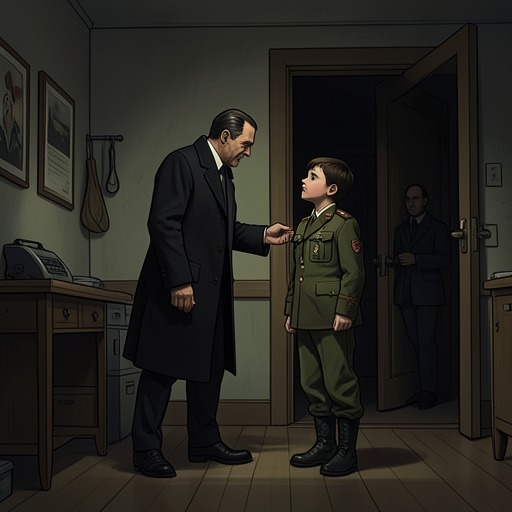
The escape follows a period of unusually severe confinement. The guerrillas had marched Jack and his companions into a fair-sized cave, tied them to jagged rocks at the rear, and settled around a fire to drink, smoke, and play cards. Jack and the others remained there for two days. Their captors treated them brutally and supplied barely enough food to keep them from starving, while Pete Gendron repeatedly insulted Jack and even declared that, if he were Dr. Mackey, he would shoot him to obtain the money for himself.
The cave was therefore more than a hiding place: it was a space in which the guerrillas exercised arbitrary power over prisoners whose movements, food, and future were entirely controlled by others. Jack’s danger was enlarged by Dr. Mackey’s plan. When Jack demanded to know what would happen to him, Dr. Mackey said that he intended to take him out of the country, refusing to say where. The departure would occur probably the following night or the day after, and Old Ben was also to be taken. The threatened removal transformed captivity into a race against time; escape had to occur before the prisoners could be transferred beyond immediate reach.
The Storm Creates an Opening
With the setting sun, a strong breeze rose over the mountains, and heavy clouds obscured the sky. Dr. Mackey had left the cave about half an hour earlier, while one of the guerrillas remarked that a severe storm was approaching. Jack understood that the weather could either close the route or conceal an attempt to flee. If the guards remained inside the cave, his chances would be poor, but the gathering darkness offered the concealment that daylight denied him.
During the storm’s approach, Jack worked energetically at his bonds. He did not wait for a formal rescue or for the return of the armies; he converted an external disturbance into a practical escape plan. At last he freed himself without making a noise, rolled over, and released Old Ben and Columbus Washington. This is the first decisive shift in the episode: the prisoner who had been fastened to the cave’s rear became the person capable of changing the position of everyone else.
Seizing the Guards and Leaving the Cave
A shout outside announced that a guard had discovered a traveler on the trail, whose two horses were loaded with store goods. Most of the guerrillas rushed out in pursuit, leaving only two men behind. One remaining guard was more than half overcome by liquor. Jack immediately assigned roles: he and Old Ben would attack the armed man, while Columbus Washington would silence the sentinel sitting on a rock, preventing either guard from calling for help.
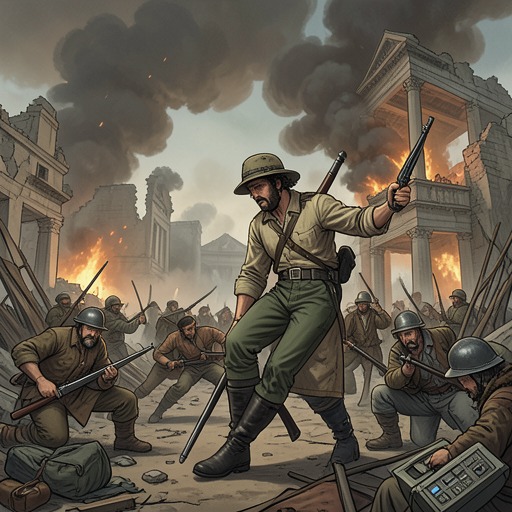
The plan succeeded quickly. Jack seized the gun while Old Ben caught the armed guard from behind and covered his mouth. Jack leveled the weapon and threatened the man into silence. The half-tipsy sentinel was captured just as easily. Both guards were disarmed and forced into the cave, where Jack warned them that any outcry would bring the fugitives back with deadly consequences. The scene reverses the earlier power arrangement without pretending that the danger has disappeared: the captives gain weapons and mobility, but they must still rely on surprise, coordination, and the storm.
Jack then directed Old Ben and Columbus Washington down the mountain. A rifle shot sounded to their right, so they moved left rather than follow the most obvious route. The storm broke over the mountains with lightning, thunder, and falling trees. Its violence hid their movement and made pursuit hazardous. Old Ben judged that the guerrillas would be more concerned with returning to the cave than following them through such weather, and the fugitives continued until they could stop and recover their breath.
Temporary Shelter and Continuing Danger
The escape does not end in safety. Old Ben knew of a cabin farther down the trail, on a bend, and the party went there. The building was deserted because its owner had joined the soldiers a year earlier, while his wife and children were staying with relatives in town. The emptiness of the cabin provided immediate shelter, and the three men entered and made themselves as comfortable as circumstances allowed.
Within half an hour, however, voices outside filled them with fresh alarm. The cabin thus repeats the cave’s spatial pattern in altered form. The cave had been a place of forced confinement under guerrilla control; the cabin becomes a provisional refuge chosen by the fugitives, yet its safety is fragile because hostile or unknown people may already be nearby. The movement from cave to cabin is consequently not a final return to freedom but the next stage of flight.
Narrative Significance
The episode gathers several of Jack Ruthven’s central conflicts into one physical action. His uncertain identity has already exposed him to competing claims and schemes, while Dr. Mackey’s intention to take him out of the country makes his body and future objects of criminal control. In the cave, those pressures become literal bonds, hunger, armed surveillance, and the possibility of disappearance. Escape is therefore both bodily and narrative: Jack refuses to remain an object passed between conspirators and becomes the agent who determines the next direction of the story.
The episode also contrasts the guerrillas’ disorder with Jack’s disciplined cooperation. The outlaws spend their time drinking, smoking, and playing cards, and one guard is incapacitated by liquor; Jack, by contrast, watches conditions, assigns tasks, secures the gun, controls the prisoners, and chooses a route through the storm. Old Ben and Columbus Washington are not passive burdens but active allies whose release and participation make the escape possible. Their movement together down the mountain gives the episode its moral as well as tactical force: solidarity and practical courage answer coercion, greed, and brutality.
The storm functions as both concealment and ordeal. It darkens the cave enough for Jack to work at his bonds, scatters the guards when an outside traveler attracts them, and covers the fugitives’ descent with thunder, lightning, and the crash of falling trees. Yet nature does not solve the problem for them. Jack must recognize the opportunity, act silently, coordinate the attack, and keep moving after the guards have been subdued. The result is a genuine change in value from imprisonment toward freedom, though the alarm at the cabin makes clear that freedom remains incomplete and must still be defended.